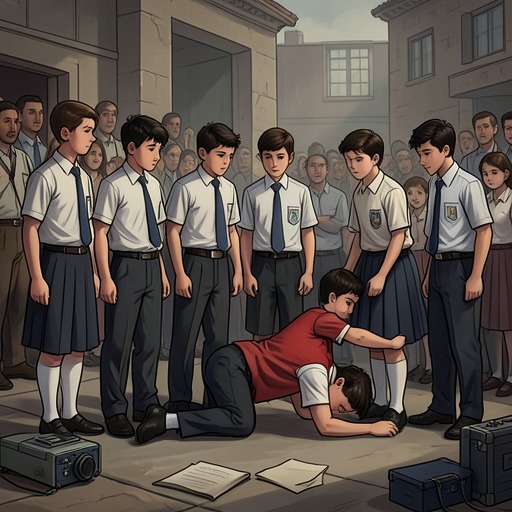
Eli breaks into the pool, rescues Oskar, and kills Jonny and Jimmy
Let the Right One InEli breaks into the pool, rescues Oskar, and kills Jonny and Jimmy in a sudden reversal at Blackeberg School’s swimming pool. The scene hinges on Micke’s decision to let the girl outside come in: while Oskar is being held underwater, that brief permission precedes Eli’s arrival and the end of the attack. By the following day, Oskar is missing, two youths are dead, and the witnesses’ account has acquired a name for the rescuer: an angel.
The Invitation at the Window
Micke is waiting in a corner of the pool area for the teacher, whom Patrik has gone to fetch. He has withdrawn beside a dark glass door that looks onto the night. When something strikes the door, he looks through the small upper window and sees a girl outside, looking up at him and asking to be let in. At first he does not understand what she wants. His attention keeps returning to the pool, where Oskar has stopped moving while Jimmy holds his head underwater.
A second, harder impact brings Micke back to the window. He sees details that make the visitor seem unlike an ordinary child, but his immediate concern is the assault in the pool. Faced with both the unfamiliar figure outside and Oskar’s peril, he gives the permission she is asking for, almost inaudibly. The scene makes that answer more than a verbal exchange: the request and Micke’s assent mark the turning point between the boys’ apparent control of the pool and Eli’s intervention.
After Micke speaks, the girl draws away from the door and vanishes into the darkness. The text does not show a conventional entrance through that door. Instead, a moment later a point of light appears in the dark central window, and the reinforced glass bursts outward into small rounded fragments. Their scattering reaches the hall and the edge of the pool. This abrupt breach carries the action from Micke’s encounter at the perimeter into the violence already underway inside.
The Attack Reversed
As the window breaks, Jimmy has lifted Oskar’s head from the water. He takes the stiletto back from Jonny and moves it toward Oskar’s face. The danger is therefore still active when Eli arrives: Oskar has been held under, and Jimmy is preparing to continue the assault. Eli’s intervention changes the outcome at the point when Micke has little reason to believe that Oskar can be saved.
The event’s decisive action is both rescue and retaliation. Oskar survives, while Jonny and Jimmy are killed. The account does not dwell on the deaths as a fight between evenly matched opponents; it presents Eli’s arrival as an overwhelming interruption of the boys’ attack. The value at stake shifts from Oskar’s imminent loss of life to his rescue, but that rescue is inseparable from the deaths that leave the witnesses trying to understand what entered the pool.
The sequence also leaves Oskar’s fate unresolved to those who investigate the scene. He has been saved from drowning, yet he is not found with the other boys afterward. The rescue thus does not end in a straightforward reunion or explanation: Eli has intervened, and Oskar has disappeared from the place where the attack occurred.
What the Witnesses Can Report
On Friday, 13 November, Gunnar Holmberg is at Blackeberg School, reviewing the scene, speaking with students, and trying to organize his notes. Technicians and a bloodstain analyst from the National Laboratory of Forensic Science are still securing evidence by the pool. Holmberg learns that two youths were killed there the previous night and that a third boy is missing. The missing boy is Oskar Eriksson, whom Holmberg remembers from a classroom discussion three weeks earlier.
The students’ accounts broadly agree on the central claim that Oskar was rescued, but one word recurs in their descriptions: angel. Witnesses also describe the rescuer in extraordinary terms, including wings and teeth unlike an ordinary person’s, and remember the glass breaking, the stiletto, and Oskar’s peril in the water. Holmberg’s notes preserve those details as reported fragments rather than resolving them into a plausible account. A crime-scene photographer has used an underwater camera to record the two dead boys where they were found; when Holmberg passes on the witnesses’ description, the photographer doubts that such an angel could have come from heaven.
The investigation therefore has tangible evidence and a repeated story, but not an explanation that comfortably joins them. The witnesses’ use of angel identifies the rescuer by the effect of her appearance and actions, not by an account the police can verify. Holmberg looks for a reasonable explanation, yet his notes return him to the same unresolved particulars. His wish to leave for a while gives the episode’s aftermath a quiet counterpoint: even the investigator charged with ordering the accounts cannot make them ordinary.
The Rescue’s Unsettled Ending
The event’s conclusion is deliberately divided. In the pool, Eli’s arrival prevents Oskar’s death and ends Jonny and Jimmy’s attack. In the investigation the next day, however, the surviving boy is absent, the other two are dead, and the witnesses’ description remains outside the categories Holmberg can confidently use. The schoolyard flag is at half-mast, an official sign of mourning set against the students’ extraordinary account of what happened.
The rescue is therefore not only a climax to Oskar’s immediate danger but also the point at which the story’s private and public realities separate. Micke experiences a girl asking to enter and consents; the boys experience a rescuer they call an angel; Holmberg receives statements and physical evidence without finding a reasonable explanation. The same event is legible to each witness in a different way, while Oskar’s disappearance keeps its consequences open. Eli saves him, but the scene offers no public confirmation of where he has gone or what follows between them.